
Enes Akdağ – Kadir Has University, Üsküdar University
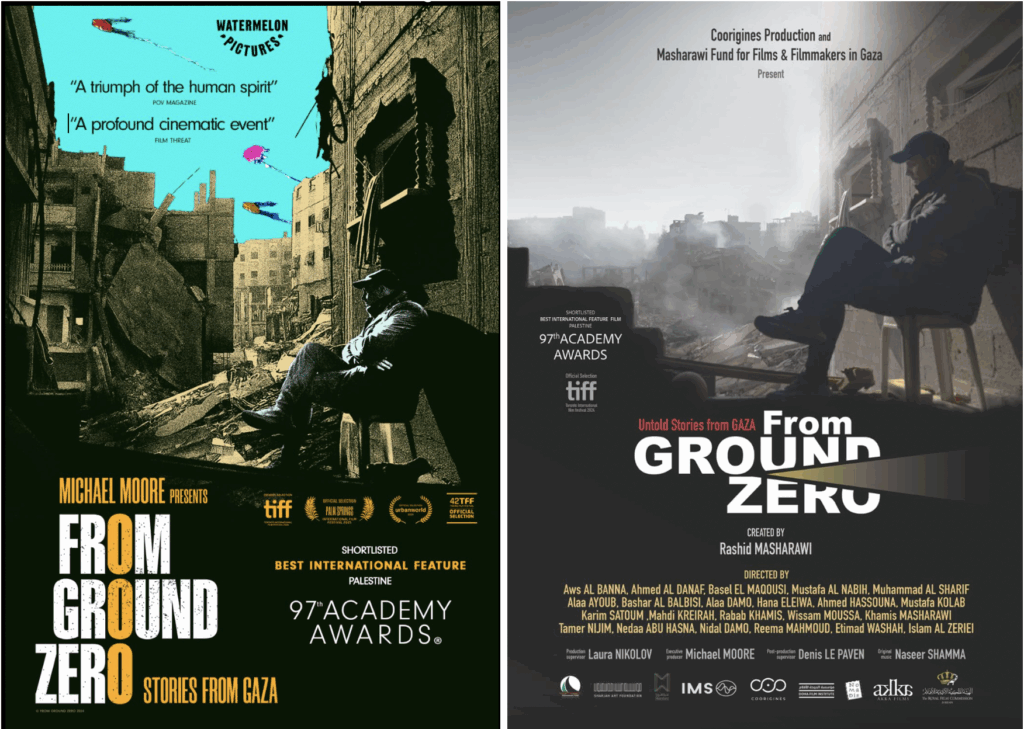
Following the release of From Ground Zero (Palestine, 2024)—an anthology comprising twenty-four short films conceived under the general direction of Gaza-born filmmaker Rashid Masharawi — I was prompted to assemble a systematic overview of the institutions that support short-film production and distribution in Palestine, alongside a curated selection of significant short works by prominent Palestinian auteur directors.
The principal institution supporting emerging Palestinian filmmakers in the domains of short film production and distribution is the Masharawi Fund for Films & Filmmakers, established in Gaza by Masharawi. Also providing financial and logistical support, the fund offers sustained artistic oversight, with Masharawi personally accompanying each project from pre-production through to post-production. The fund’s mandate is deliberately focused: it exclusively backs short films produced on mobile phones within Gaza, and it operates without a formalised application cycle. Moreover, the fund serves as a key informational resource, enabling visitors to access further materials related to Palestine-based film productions.
For filmmakers pursuing distribution and exhibition pathways, the Gaza Film Unit often constitutes the first point of contact. Through its extensive network of international partnerships, the Unit has facilitated the circulation of numerous short films by emerging Palestinian directors, enabling their works to be showcased before European audiences at major festivals such as the Uppsala Short Film Festival (Sweden), the Grimstad Short Film Festival (Norway), and the Glasgow Short Film Festival (Scotland).
Established in the United States by brothers Badie and Hamza Ali, Watermelon Pictures has garnered visibility through its acquisition of U.S. distribution rights for From Ground Zero. The company maintains an extensive online catalogue featuring a broad range of Palestinian productions dating back to 2008, although its primary focus remains the distribution of feature-length films. The catalogue additionally offers detailed information regarding the streaming platforms on which these titles are currently available, thereby serving as a centralized resource for accessing contemporary Palestinian cinema.
Directed by Yasmine Hamayel and Ayman Annimer, Shashat Women Cinema Filmlab Palestine is dedicated to supporting emerging Palestinian women filmmakers. With funding from institutions such as the European Union, the French Cultural Center, the Heinrich Böll Stiftung, and the Cervantes Institute, the organisation has thus far convened ten editions of the Annual Women Film Festival. Significantly, the festival provides Palestinian audiences with access to short films produced by women directors living in exile, thereby broadening the representational and geographic scope of contemporary Palestinian cinema. In parallel, a comprehensive directory entitled Palestinian Women Filmmakers — listing women directors and producers— is currently under development.
On MUBI, short films by prominent Palestinian auteurs —most notably Elia Suleiman and Hany Abu-Assad— are periodically showcased within time-limited, curatorially structured programs, alongside a broader selection of Palestine-themed titles. For viewers seeking access to lesser-known Palestinian short films and documentaries, the Jordan-based subscription video-on-demand platform Istikana also warrants consideration. Frequently described as “the MUBI of the Arab world,” Istikana would nevertheless benefit from a renewed marketing strategy aimed at enhancing the visibility and depth of its short-film catalogue—potentially through strategic partnerships with regional film festivals or through the acquisition of additional works by established Palestinian filmmakers.
Below, I provide a curated list of Palestinian auteur directors whose short films most powerfully articulate the lived experience of being Palestinian and the aesthetic and political configurations of resistance, accompanied by my personal reflections on the works that have left a sustained impression on me.
A Boy, A Wall and A Donkey (Hany AbuAssad, 2008).

Produced in 2008 as part of a cycle of twenty-two short films responding to themes articulated in the Universal Declaration of Human Rights, A Boy, A Wall and A Donkey examines how the cinematic aspirations of three young Palestinian boys are disrupted by the intrusive presence of a wall-mounted surveillance camera—an emblematic technology of domination. After experimenting with the doorbell camera of their affluent neighbours and discovering that it does not record, the boys set out with their donkey toward a nearby separation wall equipped with a far more advanced, rotating surveillance device. Convinced that such a camera could enable them to create a “better film,” they project their filmmaking fantasies onto this apparatus, only for their imaginative pursuit to be abruptly terminated by the sudden arrival of a military vehicle adjacent to the wall.
Available on: YouTube

Condom Lead (Arab Nasser & Tarzan Nasser, 2013).
Inspired by Israel’s twenty-two-day assault on Gaza in 2009, this satirical short by Arab and Tarzan Nasser centers on a couple whose attempts at intimacy are continually interrupted by the sonic aftermath of Israeli bombardment and destruction. Nominated for the Short Film Palme d’Or at the 2009 Cannes Film Festival, the film is particularly noted for its memorable scenes in which the couple inflates unused condoms as makeshift balloons for their child. Through this juxtaposition of domestic tenderness and wartime violence, the film interrogates the persistence —and precarity— of human sexuality and affective life amid conditions of chaos and armed conflict.
Available on: YouTube

Cyber Palestine (Elia Suleiman, 1999).
The short film I find most compelling in both narrative and affective terms is Elia Suleiman’s Cyber Palestine. Set in Gaza, the film follows Mary and Joseph after they receive a phone call from Gabriel instructing them to travel to Bethlehem in anticipation of Mary’s imminent childbirth. Travelling by motorcycle, the couple eventually arrives at a checkpoint on the outskirts of Bethlehem, where an Israeli soldier’s pointed question—“So, who is the father of this child?”—provokes a tense confrontation. The narrative is punctuated by inserts of archival footage from the Intifada, which interrupt and refract the diegesis, situating the biblical allegory within the lived realities of occupation. The film concludes with Mary seizing a symbolic key and departing on the motorcycle. In my reading, this key simultaneously evokes the keys preserved by displaced Palestinians as emblems of the right of return and, potentially, the key to the Church of the Holy Sepulchre in Jerusalem, thus layering religious, historical, and political symbolism within the film’s closing gesture.
Available on: YouTube

Make A Wish (Cherien Dabis, 2006).
Cherien Dabis’s short film centers on eleven-year-old Maryam, who is determined to obtain a birthday cake for her father. Within a household where every family member must contribute economically, such a cake constitutes an unaffordable luxury. Nevertheless, Maryam persists and eventually saves enough money to purchase one. The film culminates in a poignant reversal: her father cannot blow out the candles, as the cake is placed before a photograph of her deceased father, transforming Maryam’s gesture of celebration into an act of remembrance.
Available on: YouTube

Palestine (Kodak Cinegraph, 1929).
This ten-minute film, assembled from footage captured during Kodak Cinegraph’s global tour, documents a range of sacred sites in Jerusalem associated with the three Abrahamic religions, including the Church of the Holy Sepulchre, the Western Wall, the Mount of Olives, and Al-Aqsa Mosque. Beyond its devotional and architectural focus, the film is noteworthy for its depictions of everyday life along the Dead Sea, scenes of treasure hunters at work, and the arrival of early Zionist settlers by train—images that together provide a valuable visual record of the region’s social and political transformations in the early twentieth century.
Available on: The Travel Film Archive

The Present (Farah Nabulsi, 2020).
Winner of the International Audience Award at the 2020 Clermont-Ferrand Short Film Festival, The Present follows Yousef—portrayed by Saleh Bakri—as he sets out to purchase a refrigerator as a wedding-anniversary gift, accompanied by his seven-year-old daughter, Yasmine. Their journey requires them to traverse multiple checkpoints between their home and Beitunia, subjecting them to repeated delays and humiliating scrutiny. On their return, Yousef, now carrying the refrigerator, encounters yet another round of interrogation at a checkpoint. In the film’s culminating scene, Yousef and Yasmine defiantly push the refrigerator forward, moving past the soldiers until they recede into the distance. Through this deceptively simple narrative, the film powerfully conveys how the everyday joys, resilience, and quiet persistence of Palestinians can unsettle —and symbolically disrupt— the authority of the occupying soldiers.
Available on: Dailymotion
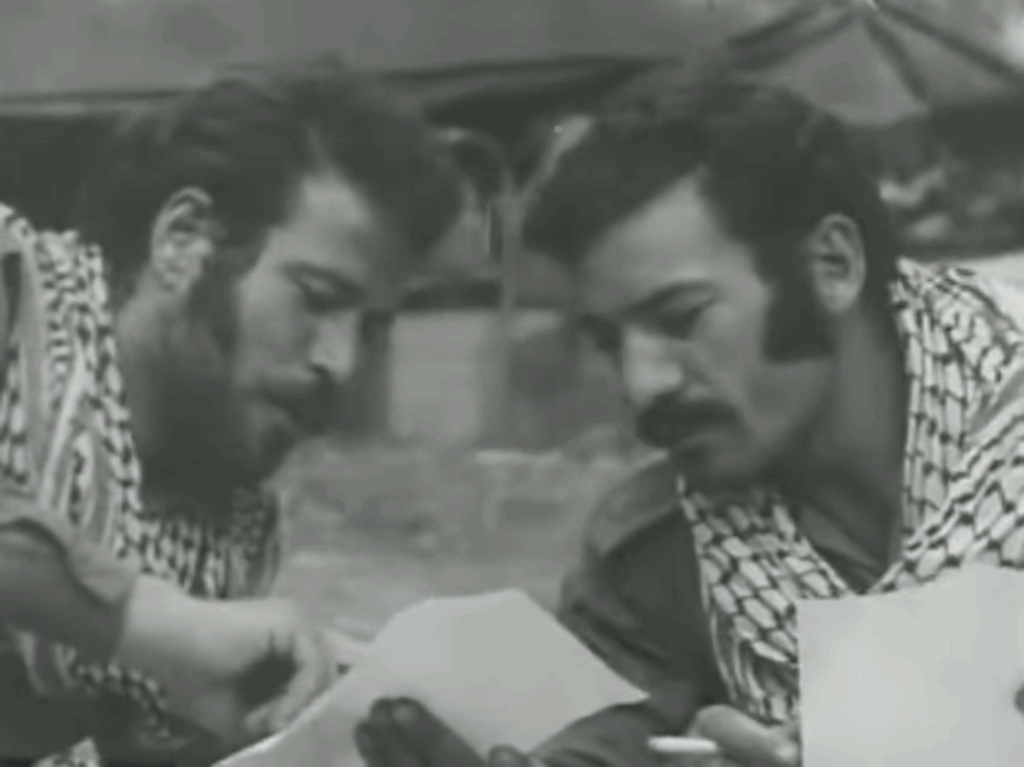
They Do Not Exist (Mustafa Abu Ali, 1948).
A seminal work by Mustafa Abu Ali—one of the principal filmmakers of the Palestinian Liberation Organization—They Do Not Exist takes its title from Golda Meir’s notorious claim: “Palestinians! Who are they? They never exist!” Opening with Rubaiyyat al-Khayyam, composed by Riyad al-Sunbati and performed by Umm Kulthum, the film depicts everyday life in the Nabatiya refugee camp in the early 1950s. Structured into nine brief segments, it operates less as a linear narrative than as a historical reckoning with recurring violence across generations. Scenes of ordinary life—children eating ice cream, men drinking coffee, neighbours conversing—are shattered by footage of the 1974 Israeli airstrike that obliterated the camp. Homes and streets vanish; the world previously shown disappears entirely. As Frantz Fanon reminds us, the history of colonialism is also “the history of being born somewhere by chance and dying somewhere else for reasons equally random.”
Available on: YouTube
Enes Akdağ is an Istanbul-based filmmaker and a Ph.D. candidate in Communication Studies at Kadir Has University. He holds an M.A. in Media and Communication Studies and a B.A. in Political Science and International Relations. His up-to-date research interests lie in the fields of film industries, new cinema history, and politics of representation. He recently joined the New Media and Communication Department of Üsküdar University, as a research fellow.